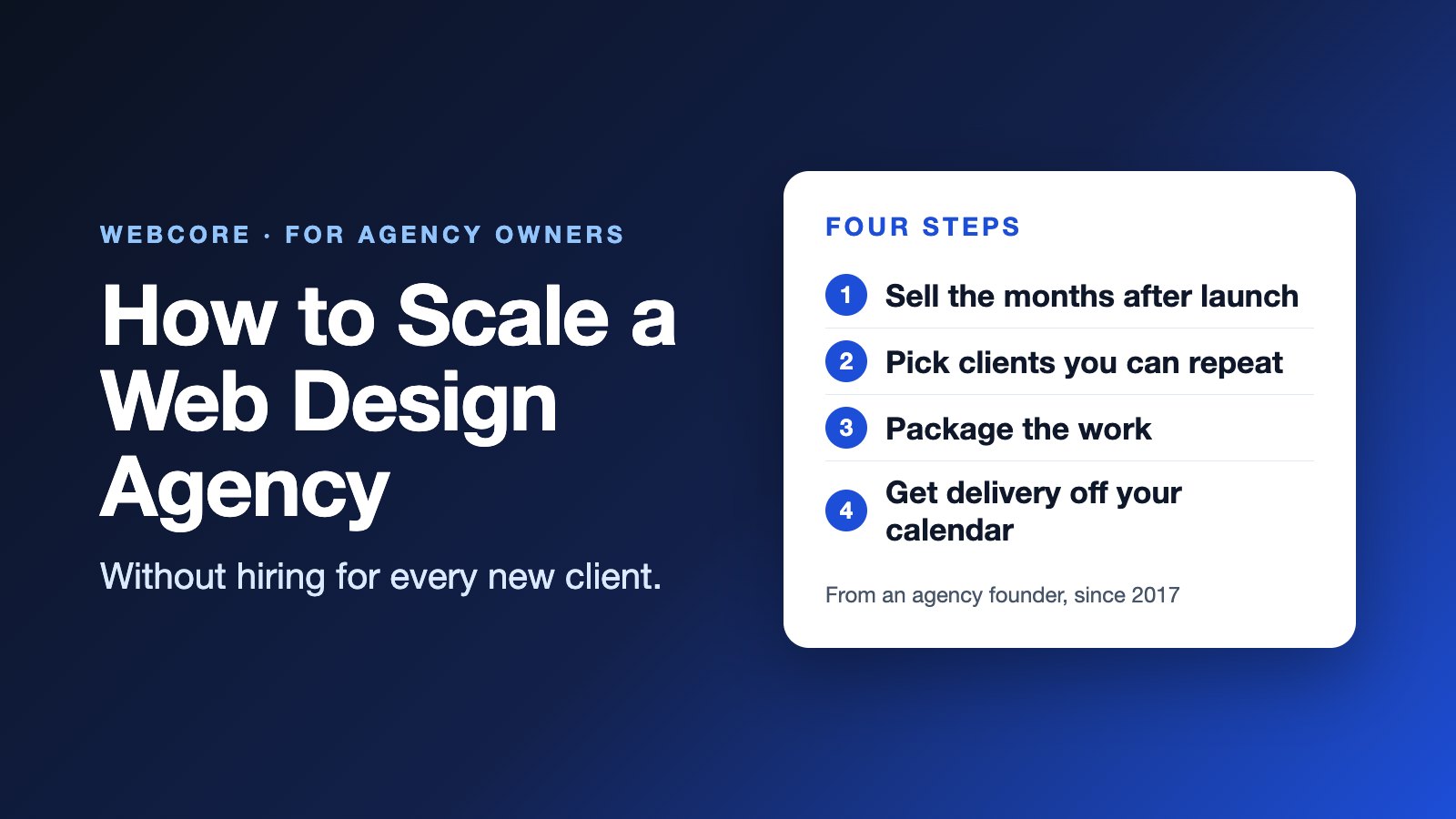
How to Scale a Web Design Agency Without Hiring for Every New Client
Quick answer: To scale a web design agency, stop selling only launches and start selling the months after them. Pick a kind of client you can serve again and again, package the work they need every month, and take the routine delivery off your own calendar, with a team, a partner or an agent inside every client site. Then measure revenue per hour, not per project.
Most web design agencies don't stall because they run out of clients. They stall because every new client comes with a calendar.
The launch is the easy part. You quote it, build it, get paid. Then the texts start. A new photo for the team page. Holiday hours. A price change. "Can you make the button bigger?" Each request is small, each one waits for you, and every new client adds a few more.
I know that shape from the inside. I started OrbitWeb in 2017, building websites and running Google Ads for local businesses. The work paid off for clients: MTS Moving's revenue grew 400% with the site we built and the ads we ran. But our growth had a ceiling, and the ceiling was my week. More clients meant more small requests, more late nights and less time for the work that grows an agency. Our own website was always last in line, which I wrote about in The Cobbler's Children.
Here's what I'd tell any agency owner who's hitting that ceiling now.
Why web design agencies stop growing at the same size
A one-time project agency starts every month at zero. Whatever you billed last month, you have to sell again this month, and you have to deliver while you sell.
On top of that sits the slow pile: the clients you already launched. Each one keeps generating work, but rarely revenue. Changes get done as favours, or as small invoices nobody enjoys sending or paying. Care plans get questioned at renewal, because the client can't see what they paid for.
So the agency grows until the owner's hours run out, then holds there. Adding a person helps for a while, until their hours run out too. That's the trap of hiring for every new client.
Scaling means breaking the link between clients and hours.
Step 1: Sell the months after launch, not only the launch
The fastest way to scale a web design agency is to make each client worth something every month. Recurring revenue is what lets you plan, hire on your own schedule and turn down the wrong projects.
But a monthly fee only lasts if the client feels it. A care plan that means "we update plugins" gets cancelled in the first tight month. A plan that means "your changes go live the same day, your site gets faster, and new pages bring you calls" gets renewed.
The test is simple. At renewal time, can your client name three things that changed on their site because of you? If they can't, the fee is at risk, however good the work behind the scenes was.
Step 2: Choose clients you can serve again and again
Scale comes from repetition. If every client is a different kind of business, every site is a new puzzle and every month brings new questions.
Pick a group you already understand: trades, clinics, restaurants, real estate, whatever you do well. Their sites need the same pages, their customers ask the same questions, and the fixes repeat.
Local trade and clinic sites show how much repeatable work is out there. This fall we measured 1,277 Ontario trade and clinic websites on a phone for our Ontario Trades Web Index. The median one took 8.3 seconds to show its headline, where Google calls 2.5 seconds good, and about half published no local business details a search engine can read. The same gaps show up site after site, which means the same fixes can too.
Step 3: Turn your service into a package
Packages scale. Custom quotes don't.
Write down what every client on a monthly plan gets, in words an owner understands:
- The changes they ask for, live the same day
- Search basics kept current on every page
- One new page or article a month, about a service or a town they serve
- Speed checked the way Google measures it
- A short note each month: what changed and why
Then price the package by what it's worth to the client, not by your hours. When your delivery gets faster, a package keeps the margin. An hourly rate gives it away.
Step 4: Take delivery off your own calendar
This is the step most owners skip, and it's the one that decides whether the agency scales. There are three ways to do it.
| | Who does the monthly work | What it costs you | What to watch |
| --- | --- | --- | --- |
| Hire | A designer or developer on your team | A salary, before the clients arrive | Their hours run out too |
| Outsource or white-label | A contractor or another agency | Their rate on every task | Quality and turnaround you don't control |
| An agent in every client site | Software that makes the changes and the search work, with your team approving | A platform plan, often paid by the client | Your team still owns the strategy and the relationship |
Most agencies end up mixing them. The real question is which one carries the routine work, the changes and updates that arrive every week, so your people spend their time on the work clients actually pay you for.
How to scale a web design agency with an agent in every client site
This is what I built WebCore for, first for OrbitWeb and now for other agencies through our partner program.
Every client site gets its own AI agent, with its own memory of the business and its brand rules. Your team asks it for a change in one sentence, reads exactly what it changed, and publishes the same day. Every publish writes the search basics into the site: titles, descriptions, business details, a sitemap and an llms.txt for AI assistants. From the Starter plan, the agent also works on speed and writes articles from a 15-minute interview with the owner, each one scored on 23 checks.
Here's a Tuesday. At 7:40 a.m., a roofing client texts you about a storm-season offer. You open their workspace, ask their agent in one sentence, check the change and publish. Mid-morning, a dental client wants a page about implants. The agent interviews the dentist and drafts the page in the dentist's own words, and your strategist edits instead of writing from scratch. None of it waited for a developer or a ticket.
The business side works like a Google Ads manager account:
- Your partner account is free, and so are your staff seats.
- Each client pays its own WebCore plan, from $99 a month, and owns its workspace.
- You bill for your work and keep all of it. There are no commissions to track.
- You stay the agency. The agent can stay behind the scenes, or the owner can talk to it. That's your call.
Partners earn a badge their prospects can check: Partner at three paying clients, Premier at ten.
The numbers that tell you it's working
Project count is a vanity number. These four tell you whether the agency is getting easier to run as it grows:
1. Monthly revenue per client. Is each client worth more every month than a year ago?
2. Hours per client per month. Is it going down as you add clients?
3. Time from a client's request to live. Same day is the goal.
4. Clients per person on your team. Hiring for every new client never moves this one.
An example, with made-up numbers. Say you bill 20 clients $400 a month for managing their sites and marketing. That's $8,000 a month before you sell a single launch. If each client takes four hours a month, that's 80 hours, two full weeks of someone's time. Cut it to one hour per client, and the same 80 hours covers 80 clients, or you spend 60 of them selling.
What you should never hand off
Scaling isn't about removing yourself from your clients. Keep the parts that make an agency worth hiring:
- The relationship. Owners stay with people they trust.
- The strategy. Which services to push, which towns to win, what the site should say.
- The judgement. Reading what changed before it goes live.
Hand off the routine work. Keep the thinking.
If the ceiling in this article sounds familiar, our partner program is built for agencies like yours. We're opening it to a small group of agencies first, and I set up each one with them, first client sites included.
Keep reading
- How to Choose an SEO Company: Check Their Own Website First
- the Ontario Trades Web Index
- the local SEO playbook your agent runs
Frequently Asked Questions
Q: How do I scale a web design agency? Sell the months after launch, not only the launch. Choose a kind of client you can serve again and again, package what they need each month, and take the routine delivery off your own calendar with a team, a partner or an agent in every client site. Track revenue per client and hours per client every month.
Q: Should I hire or outsource first? Neither, until the routine work is packaged. Hiring or outsourcing work that isn't packaged moves the chaos onto someone else's calendar. Write down what every client gets each month, then decide who or what delivers it.
Q: How do web design agencies get recurring revenue? With monthly plans whose value clients can see: changes live the same day, search work shipped on the site, and new pages that bring calls. A plan that only promises updates in the background is the first thing cut in a tight month.
Q: What should a website care plan include? The changes clients ask for, search basics kept current, speed checks, hosting and backups, one piece of new content a month, and a short note of what changed. Describe it in outcomes the owner understands.
Q: How much should I charge for website management? Price the package by what it includes and what it's worth to the client, not by your hours. When your delivery gets faster, a package keeps the margin and an hourly rate gives it away.
Q: Can a small web design agency compete with bigger ones? Yes, if it picks a niche and responds fast. Owners stay with agencies that answer quickly and show results. A small team with the routine work handled can turn a request around the same day, and owners notice.
Q: Will AI replace web design agencies? It replaces routine work, not the agency. Owners still want someone they trust to decide what their site should say and do. Agencies that hand the routine work to an agent can serve more clients with the same team. More in Does WebCore replace my agency?
Q: How does the WebCore partner program work? Your partner account and staff seats are free. Each client approves your access once, owns its workspace and pays its own WebCore plan. You bill for your work and keep all of it, with no commissions. Start at webcore.pro/agencies.