How to Choose an SEO Company: Check Their Own Website First
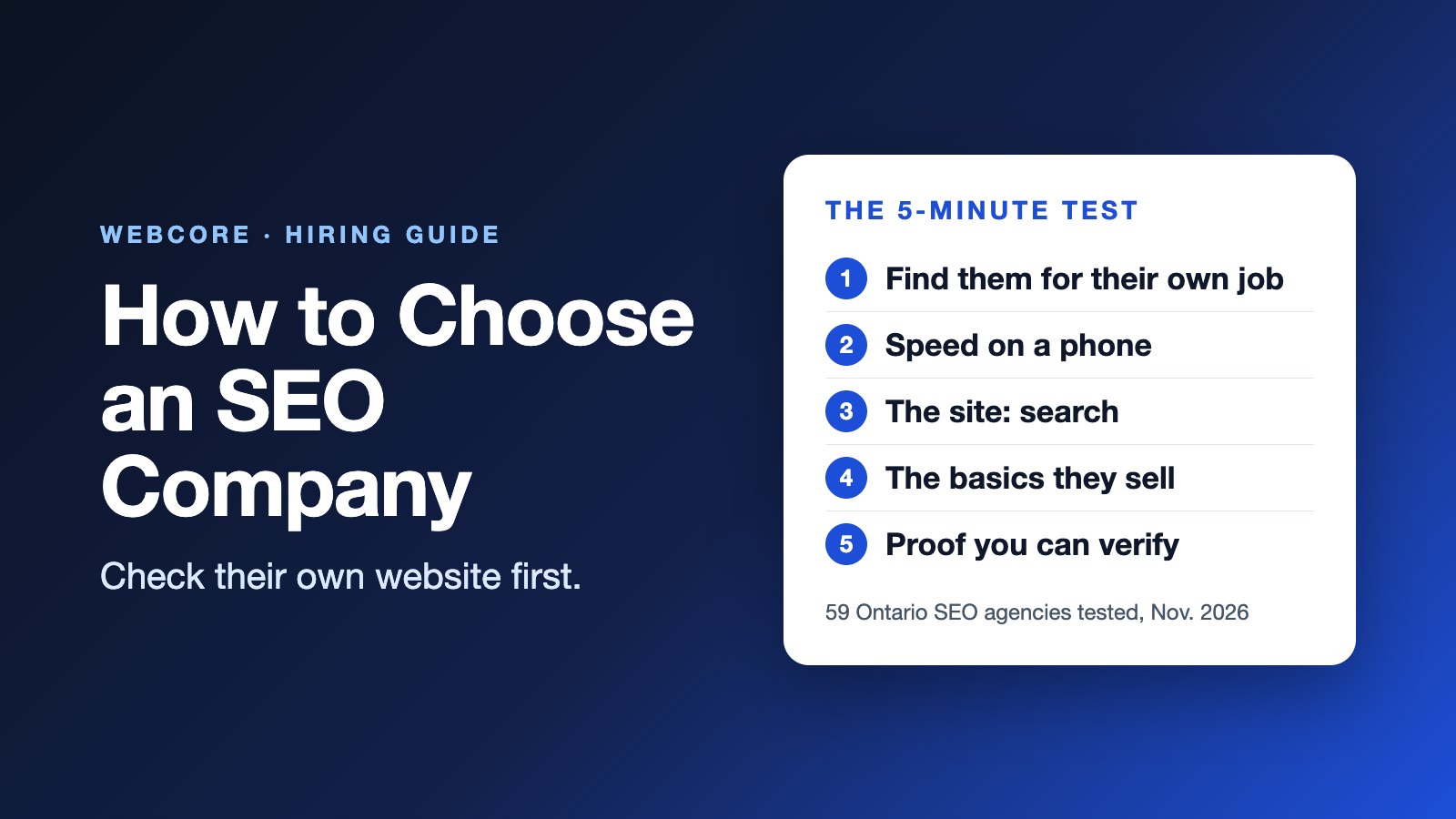
Quick answer: To choose an SEO company, start with the one website they fully control: their own. Search for their service in their own city, run their homepage through Google's speed test, do a site: search to see what Google has of theirs, and check the basics they'd charge you to fix. Then ask Google's own hiring questions, and walk away from anyone who guarantees a #1 ranking. How an agency treats its own site tells you how it will treat yours.
The email usually opens the same way. "I was looking at your website and noticed you're not on the first page of Google."
Then comes the pitch: page one, more calls, a free audit, maybe a guarantee. It sounds like someone did their homework on your business.
There's a fair question to send back. Are they on the first page?
There's an old saying for this. The cobbler's children have no shoes. The shoemaker spends every day on other people's feet and never gets around to his own family's. In marketing it's the agency that sells SEO and can't be found on Google, or sells speed from a site that takes nine seconds to load. I wrote about why it happens, from the agency side, in The Cobbler's Children on the OrbitWeb blog.
The good news is that an agency's own website is the easiest work of theirs you'll ever get to inspect. It's public, it's free to check, and nobody can blame a difficult client for it. You don't need to know SEO. You need a phone, Google, and the five checks below.
We ran the checks on 59 Ontario SEO agencies
Before writing this, we tested it. On November 4, 2026, we searched for "SEO agency" and "SEO company" in ten Ontario cities: Toronto, Ottawa, Mississauga, Hamilton, London, Kitchener-Waterloo, Barrie, Oakville and Burlington, Windsor, and Guelph and Cambridge. We took every agency website on the first page of results and dropped the directories, review sites and "best of" lists. That left 59 agency homepages, and we checked what each one gives Google.
| What we checked on each homepage | Agencies that had it |
|---|---|
| A page title | 59 of 59 (100%) |
| A meta description | 58 of 59 (98%) |
| Exactly one main heading (H1) | 52 of 59 (88%) |
| Business details in structured data | 54 of 59 (92%) |
| A sitemap | 54 of 59 (92%) |
| Words a crawler can read without running JavaScript | 59 of 59 (100%) |
| All five basics: title, description, one H1, business details, sitemap | 44 of 59 (75%) |
| An llms.txt file for AI assistants | 36 of 59 (61%) |
Most of these agencies practice what they sell. That makes sense, because we found them by searching for their own trade in their own city, which is the first test on this list. Three in four pass all five basics on their own homepage. One in four slips on at least one.
So the lesson isn't that agencies are bad at SEO. The ones you can find usually know what they're doing. The one to look at twice is the one that found you, with an email, and that you can't find back.
> Before you hire anyone to fix your shoes, look at their feet.
Check 1: Can you find them for their own job, in their own town?
Search for the service they're selling you, plus their city. "SEO company Hamilton." "SEO agency Kitchener." Look at the regular results on page one, then at the map listings.
If they're not there, ask why. Ranking for their own trade in their own city is the cheapest proof of their work there is. They don't need a client's budget or permission to do it, and every other agency in town is competing for the same search, which makes it a fair test.
There's one honest exception. Some agencies don't sell local SEO at all, and serve national or ecommerce clients instead. Then ask what they do rank for, and search that.
Check 2: How fast is their site on a phone?
Run their homepage through Google's PageSpeed Insights, or through our free website speed test, which runs the same Google test and shows the result next to 1,277 local sites. Google calls a page that shows its main content within 2.5 seconds good.
In our Ontario Trades Web Index, the median trade or clinic website took 8.3 seconds to show its headline on a phone. An agency selling you speed should be well under that on its own homepage. If its own site is slow, ask what it will do differently on yours.
Check 3: What does Google have of theirs?
Type site: and their domain into Google, with no space: site:theiragency.com. You'll get a list of pages Google has stored from their site.
Read it like a résumé. Are there real service pages, case studies you can open, articles with dates on them? Or a handful of pages, or dozens of copies of the same city page with only the town name swapped? That last pattern is the one our local SEO checklist warns against, and it's a strange thing to find on an SEO company's own site.
One caveat, straight from Google: the site: operator "doesn't necessarily return all the URLs that are indexed," so treat it as a quick look, not a count. For your own site, Google's Search Console shows the real numbers.
Check 4: Look at the basics they'd charge you to fix
These take two minutes, and they're the same items an SEO audit of your site will list.
- Their name in Google. Is the title clear and specific, and is there a real description under it, not cut off mid-sentence?
- One clear headline on the homepage that says what they do and where.
- Business details for search engines. Paste their homepage into Google's Rich Results Test and look for LocalBusiness or Organization in the results.
- A sitemap. Add /sitemap.xml to their address. A list of their pages should load.
If an agency skips these on the one site nobody else is paying for, picture what happens on yours.
Check 5: Proof you can verify
Rankings screenshots are easy to make. Look for proof that's harder to fake:
- Case studies with real names and results you could check with the business.
- Their own Google reviews, how many, how recent, and whether they answer them.
- How long they've been in business, and in your kind of business.
- What they'll show you every month. Changes made and why, not just a rankings chart.
The questions Google says to ask
Google publishes its own advice on hiring an SEO, and it opens with a fair point: "As with many business activities, sometimes hiring a professional can be helpful." Its suggested questions include:
- "Can you show me examples of your previous work and share some success stories?"
- "What kind of results do you expect to see, and in what timeframe? How do you measure your success?"
- "What's your experience in my industry?"
- "What's your experience in my country/city?"
- "How long have you been in business?"
Add one of your own: "Can I see your site in PageSpeed Insights right now?"
The red flags Google warns about
The same Google page is blunt about the warning signs:
- "No one can guarantee a #1 ranking on Google."
- "Beware of SEOs that claim to guarantee rankings, allege a 'special relationship' with Google, or advertise a 'priority submit' to Google."
- "Be wary of SEO firms and web consultants or agencies that email you out of the blue."
- "Be careful if a company is secretive or won't clearly explain what they intend to do."
That cold email from the top of this article ticks the third box before you've read past the subject line.
What a good SEO company looks like
The best agencies pass every check here in five minutes, and many in our sample did. They show up for their own trade in their own town, their site is quick on a phone, Google has their real pages, and they'll walk you through what they change and why.
If you find one like that, hire them. Good agencies do work no tool replaces. If you run an agency that passes these checks, our partner program is built for you.
Or let your website do its own SEO
There's another way to get the basics done without trusting a stranger's email. WebCore gives your site its own AI agent. On every publish, on every plan, it writes a copy of each page that search engines and AI assistants can read, with titles, descriptions, business details, a sitemap and an llms.txt. From Starter, it also works on speed the way Google measures it. You approve every change before it goes live, and you own everything.
You can run all five checks on webcore.pro, too. Our homepage has a title, a description, one headline, business details, a sitemap, an llms.txt and more than 1,400 words a crawler can read without JavaScript.
Start with the two minutes that matter most: put your own site, or the agency that emailed you, through the free website speed test. Or see what our website management services include.
Keep reading
- the local SEO checklist
- how to rank in Google Maps
- the local SEO playbook your agent runs
Frequently Asked Questions
Q: How do I choose an SEO company? Start with their own website. Check that they rank for their own service in their own city, that their homepage is fast on a phone, that a site: search shows real pages, and that their basics are in place. Then ask Google's hiring questions and get references you can verify.
Q: How can I tell if an SEO company is any good? Look at the work you can see without asking: their own rankings, their site's speed in PageSpeed Insights, the pages Google has of theirs, their own reviews, and case studies with real business names. Good agencies pass all of it in a few minutes.
Q: How do I check what pages Google has indexed for a website? Search Google for site: followed by the domain, like site:example.com. Google notes the results aren't complete, so use it as a quick look. For your own site, Search Console's URL Inspection tool and indexing report show the real picture.
Q: Can an SEO company guarantee first-page rankings? No. Google says it plainly: "No one can guarantee a #1 ranking on Google." Treat a guarantee as a reason to keep looking.
Q: What questions should I ask an SEO company before hiring? Google suggests asking for examples of previous work, what results they expect and in what timeframe, how they measure success, their experience in your industry and city, and how long they've been in business.
Q: Should I trust an SEO company that emails me out of the blue? Be careful. Google's advice is to "be wary of SEO firms and web consultants or agencies that email you out of the blue." Check their own website before you reply.
Q: Does website speed matter when choosing an SEO company? Yes, as a test of their skill. Google calls a page that shows its main content within 2.5 seconds good. An agency that sells speed should meet that on its own homepage.
Q: Should I hire a local SEO company? Local experience helps, and Google lists "What's your experience in my country/city?" among its questions. The best local test is simple: can you find them when you search for their service in their own town?