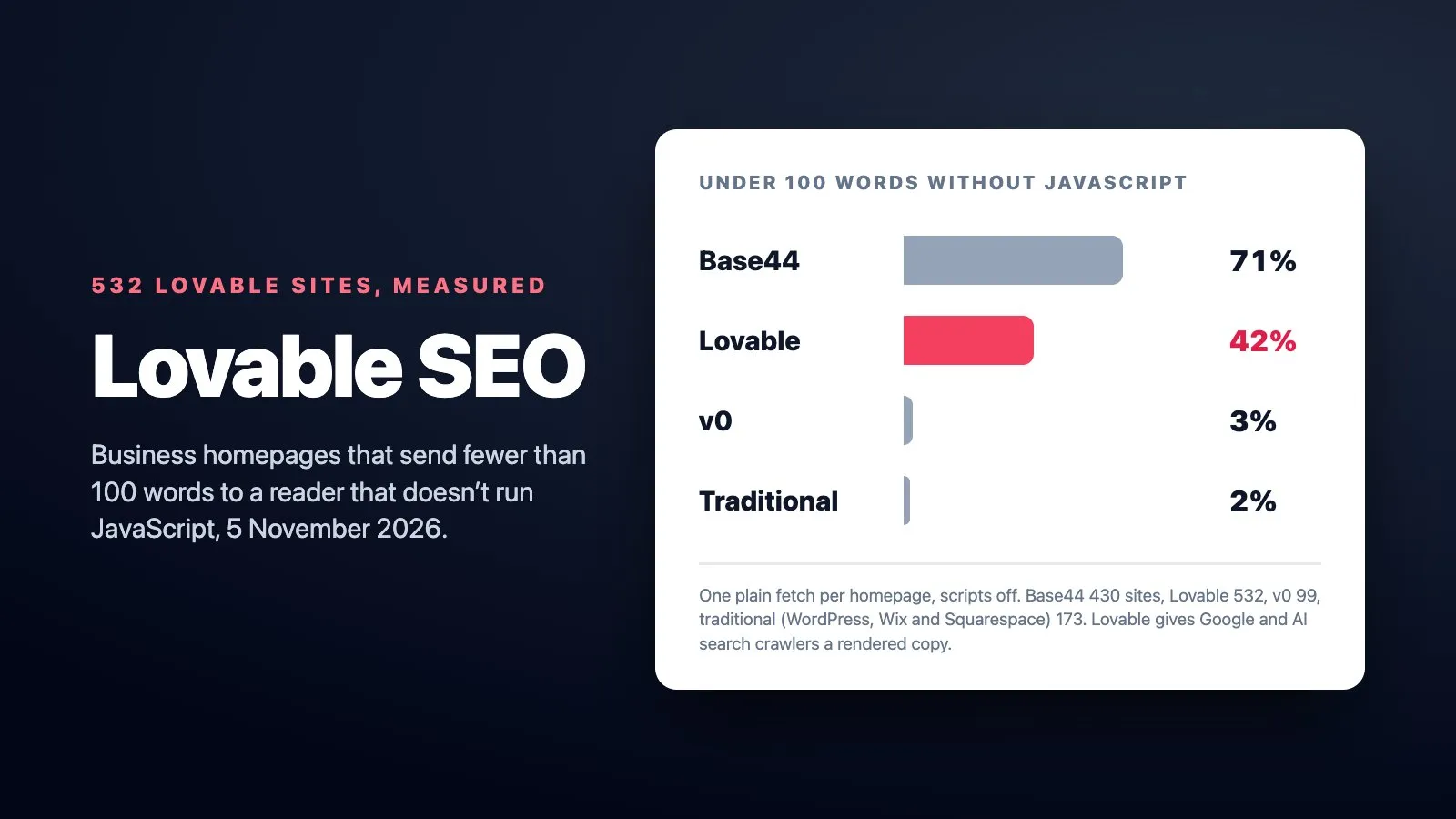
Quick answer: Lovable SEO is better than its reputation, and its weak spot is narrow. When I fetched 532 Lovable business homepages on 5 November 2026 without running JavaScript, 58% carried their full text and 42% sent back a shell of fewer than 100 words, though Lovable says Google and the big AI search crawlers get a rendered copy instead. The gaps every reader sees are plainer: only 36% described the business in structured data, and only 36% had a sitemap.
What I measured
On 5 November 2026 I measured 532 business websites built with Lovable, kept only if the homepage named a service and gave a phone number, an email or a street address. The same day, the same way, I measured 430 Base44 sites, 99 v0 sites and 188 Ontario trade and clinic sites on WordPress, Wix and Squarespace, all part of our study of 1,262 business websites.
Each homepage got two tests: one plain fetch with JavaScript off, the way a crawler that doesn't run scripts reads it, and one Google PageSpeed Insights run on the phone setting.
One detail matters most. My fetch introduced itself as a research tool, not as Googlebot, and Lovable's hosting docs warn that on older apps, scanners like mine can report a page as empty while Google, social platforms and AI search engines see the full content. That's fair, so read my text numbers as what a reader outside Lovable's verified list gets.
Here is what came back for Lovable:
- Text without JavaScript: a median of 260 words, between Base44's 28 and v0's 449. 306 homepages (58%) carried their full text, a median of 594 words. The other 226 (42%, 95% interval 38 to 47) sent fewer than 100, and the median shell held 8 words.
- Business details in structured data: 36%, against 77% of 173 traditional sites.
- A sitemap: 36%, against 98% of the traditional sites.
- Phone speed: a median PageSpeed score of 83, against 61 for the traditional sites, but the largest element showed within 2.5 seconds on only 26% of 528 sites.
What Google and AI tools see on a Lovable site
Google runs JavaScript, just not right away. Its JavaScript SEO guide says pages wait in a rendering queue, for seconds or longer, until a headless Chromium runs the scripts "once Google's resources allow". It still calls server-side or pre-rendering "a great idea" because "not all bots can run JavaScript".
Most AI crawlers don't run it at all. In research Vercel published in December 2024, OpenAI's three crawlers, Anthropic's ClaudeBot and PerplexityBot didn't render JavaScript. They read only the HTML they're handed. Gemini, which runs on Googlebot's infrastructure, and Applebot were the exceptions.
Lovable has one answer per stack. Apps created since 13 May 2026 (22 June on Enterprise) run on TanStack Start and render every page on the server, so every reader gets the full page. Older apps run on React and Vite, which Lovable's upgrade guide says send the browser "a mostly empty page" for JavaScript to fill in. For those, Lovable renders a copy on the fly for verified crawlers: Google, Bing, the AI search crawlers of ChatGPT, Perplexity, Claude and Gemini, social preview bots and verified SEO tools. In Lovable's words, "Tools outside that verified list see very little."
That lines up with my split. Almost six months after the new stack became the default, 42% of these homepages still sent my fetch the shell.
The Lovable SEO problem, in plain words
If Google gets a rendered copy, why care what my fetch got? Because the copy has problems of its own.
- You never see the copy Google gets. Your browser gets the app, and the crawler gets a snapshot. Lovable's SEO guide says content that loads late can be missing from it, and points you to Google's URL Inspection tool to check.
- Google calls this setup a workaround. Serving crawlers a rendered copy while people get the app is dynamic rendering. Google doesn't treat it as cloaking when the content is similar, but calls it "a workaround and not a recommended solution" and recommends server-side rendering, which Lovable's new stack does.
- An older app has one title and description for the whole site. Lovable's metadata guide says so, and Google asks for distinct text in each page's title so people can tell your pages apart.
- The shells were slower, too. On Google's phone test, the 223 shells with a score showed their largest element at a median of 4.6 seconds, against 3.3 for the full-text pages, and 14% made the 2.5 second mark, against 35%. That fits Lovable's own promise that server rendering gives "a faster first page load".
Lovable says its apps can rank like other modern web apps, and the basics back that up: 531 of the 532 homepages had a title, and 528 a meta description.
The gaps every Lovable site shares
These showed up on full-text pages and shells alike.
Business details in structured data
JSON-LD is a short block of code that tells search engines the business's name, address, phone and hours. Google says Organization markup on the homepage can help it understand your business and tell it apart from others. Business JSON-LD sat on 36% of Lovable homepages, and the shell isn't to blame: among the 306 full-text homepages, it was 39%. Lovable's review doesn't count a missing Organization block as an issue by itself.
A sitemap
Only 36% of the Lovable sites served a real sitemap, which matches Lovable's docs: it creates a robots.txt with every new project "but not always a sitemap". Google's sitemap guide says a small, well-linked site can manage without one, but a new site with few links from elsewhere is a case for having one.
Speed on a phone
On paper, Lovable looks best here, with that median score of 83. But Google says Core Web Vitals are used by its ranking systems, and the loading one is Largest Contentful Paint, the time until the biggest thing on the screen shows. Google's web.dev calls 2.5 seconds or less good. Only 26% of Lovable sites made it, with a median of 3.8 seconds.
The traditional sites did worse, at 5%, and the median Squarespace site took 14.3 seconds. So the gap is from Google's mark, not from the competition.
llms.txt and the agent checks
13% of the Lovable sites served an llms.txt file, a short summary of a site for AI tools that's still a proposal. Put it last. Google says you don't need "AI text files" for its AI features, and Lovable's review doesn't flag a missing one. Lighthouse's new agentic-browsing checks do read it when it's there.
On those checks, 59% of Lovable sites passed every scored audit, against 27% of the traditional sites, though Lighthouse skips audits for files a site doesn't have.
How to check your own Lovable site in two minutes
All four are free. The first three take about two minutes, and the fourth needs Google Search Console.
- Ask Lovable which stack you're on. Its docs suggest typing "What stack is this project on?" in the project chat. On TanStack Start, every reader gets the full page. On React and Vite, only verified crawlers do.
- Look at the source. Open your homepage in Chrome, right-click, choose View page source and search for a sentence from your page. If it isn't there, your text arrives by JavaScript. To see the page that way, open DevTools, press Control+Shift+P (Command+Shift+P on a Mac), run Disable JavaScript and reload.
- Run the Rich Results Test. Paste your homepage address into Google's Rich Results Test. It shows which rich result types it found in your structured data, and any errors.
- Inspect the homepage in Search Console. In URL Inspection, click Test live URL, then View tested page to see the HTML and a screenshot of what Google got. That's the copy Lovable hands to Google.
How to fix Lovable SEO
Most of these are one chat message in Lovable.
- Run the SEO & AI search review. Open More, then Analytics, then the SEO & AI tab. Running it is included on every plan, and fixes use normal credits.
- Upgrade an older app to TanStack Start. In the project chat, type / and choose Migrate to TanStack Start. Lovable puts most upgrades at 10 to 35 credits, your live site stays as it is until you publish, and you can revert from version history. Then every reader gets the full page.
- Give every page its own title and description. On the new stack you can ask page by page: "Update the meta description of the pricing page." If your browser tab still says Lovable App, you're on the template's title, like 21 of the homepages I fetched.
- Add business JSON-LD to the homepage. Ask for an Organization or LocalBusiness block with your name, address, phone and hours, then check it with the Rich Results Test.
- Get a sitemap and submit it. Ask Lovable to create one, then connect Google Search Console from the SEO & AI tab. Lovable can verify your site and submit the sitemap in chat.
- Move to your own domain. 495 of the 532 sites I measured lived on a lovable.app address, partly because that's how I found them. Lovable's docs say that address suits demos, internal tools and projects that run on social or paid traffic, and that a custom domain helps you build search presence. Custom domains are on paid plans.
- Add llms.txt if you like. Ask for a short plain-text file at /llms.txt that says what the business does and links your main pages.
- Test the speed after each change. Lovable's review no longer checks speed, so run PageSpeed Insights on the phone setting and watch Largest Contentful Paint.
Should you move your Lovable site?
Not for SEO alone, since the upgrade fixes the shell in place. Move when you'd rather not keep running the site yourself.
If that's you, WebCore, my company, imports a Lovable project from its ZIP export (here's how). WebCore is an AI for revenue: it builds a fast website and keeps it fast, answers your visitors when you're busy, and saves every enquiry as a lead. Its publish step writes pages search engines can read without running your code, plus a sitemap and an llms.txt file. It isn't perfect either: on 5 November, 3 of the 13 WebCore homepages I measured also sent fewer than 100 words. I wrote more about turning a vibe-coded site into a business asset.
How I measured
- Date and tools: 5 November 2026, 18:19 to 20:50 UTC, with robots.txt honoured and Lighthouse 13.6.0 behind PageSpeed Insights.
- Sample: 532 Lovable business homepages, 495 on lovable.app addresses and 37 on their own domains.
- Failures: PageSpeed failed on 4 Lovable sites, so speed figures cover 528. The fetch failed on 15 WordPress sites, so traditional text figures cover 173 of 188. Failures are counted, not dropped.
- My extra splits: the shell and full-text figures (8 words, 594 words, 39% and the speed split) are my own counts from the same data, not pre-registered.
- Privacy: no business is named. The full method and results are in the study.
Sources
- Lovable docs: SEO and AI search, hosting, upgrading to TanStack Start, site metadata, custom domains and the changelog.
- Google: JavaScript SEO basics, dynamic rendering, AI features, Organization markup, sitemaps, title links, page experience, recrawling, URL Inspection and the Rich Results Test.
- web.dev: Largest Contentful Paint.
- Vercel: The rise of the AI crawler, 17 December 2024.
- llms.txt: the proposal.
- Chrome DevTools: Disable JavaScript.
Frequently Asked Questions
Is Lovable good for SEO?
On the basics, mostly yes. In my 5 November 2026 test, Lovable homepages had a median PageSpeed score of 83 against 61 for WordPress, Wix and Squarespace, and nearly all had a title and a meta description. The gaps were structured data (36% against 77%), sitemaps (36% against 98%), and the 42% of homepages that sent fewer than 100 words to a fetch without JavaScript.
Why isn't my Lovable site showing up on Google?
Start with Lovable's own rules: only publicly published apps can appear, and projects with restricted access or a branded workspace address never do. Then connect Google Search Console, submit your sitemap and request indexing for your homepage with URL Inspection. Google says crawling can take a few days to a few weeks, and a new site with few links from other sites is harder for it to find.
Can ChatGPT read my Lovable site?
On Lovable hosting, Lovable says it can. Its docs say the AI search crawlers of ChatGPT, Perplexity, Claude and Gemini get a rendered copy of older apps, and apps on the new stack send everyone the full page. That copy matters, because Vercel's December 2024 research found OpenAI's crawlers don't run JavaScript. On an older app, any other tool gets the shell unless it asks for a Markdown version, which Lovable also serves.
What changed in Lovable's SEO update?
Lovable's changelog entry for 18 May 2026 announced TanStack Start, which renders pages on the server, as the default for new apps created from 13 May 2026. The same entry says older React and Vite apps get on-request pre-rendering for verified crawlers, and it announced an SEO and AI search review. Enterprise apps got the new default on 22 June, and since 28 July older projects can upgrade in place.
How do I fix SEO on Lovable?
Run Lovable's SEO & AI search review, upgrade an older app to TanStack Start, and give every page its own title and description. Then add business JSON-LD to the homepage, create a sitemap and submit it in Google Search Console, and connect your own domain. Check the result with view source, the Rich Results Test and PageSpeed Insights.
Do I need a separate pre-rendering service for Lovable?
Not on Lovable hosting. Lovable's docs say hosted projects don't need one, because older apps are pre-rendered for verified crawlers and newer apps render on the server. That pre-rendering belongs to Lovable's hosting, though, so if you exported the code and host it somewhere else, check what your own host serves with view source.
Should I move my site off Lovable?
Not for SEO alone. The upgrade to TanStack Start fixes the shell in place, and the other fixes work the same on any platform. Move when you'd rather not run the site yourself, and keep your page addresses when you do, so the links people already have keep working.
How long does Google take to pick up changes?
Google says crawling can take anywhere from a few days to a few weeks. For one page, inspect it in Search Console and request indexing, which has a quota. For many pages, submit your sitemap. Lovable's docs add that new pages can take days, and sometimes longer.