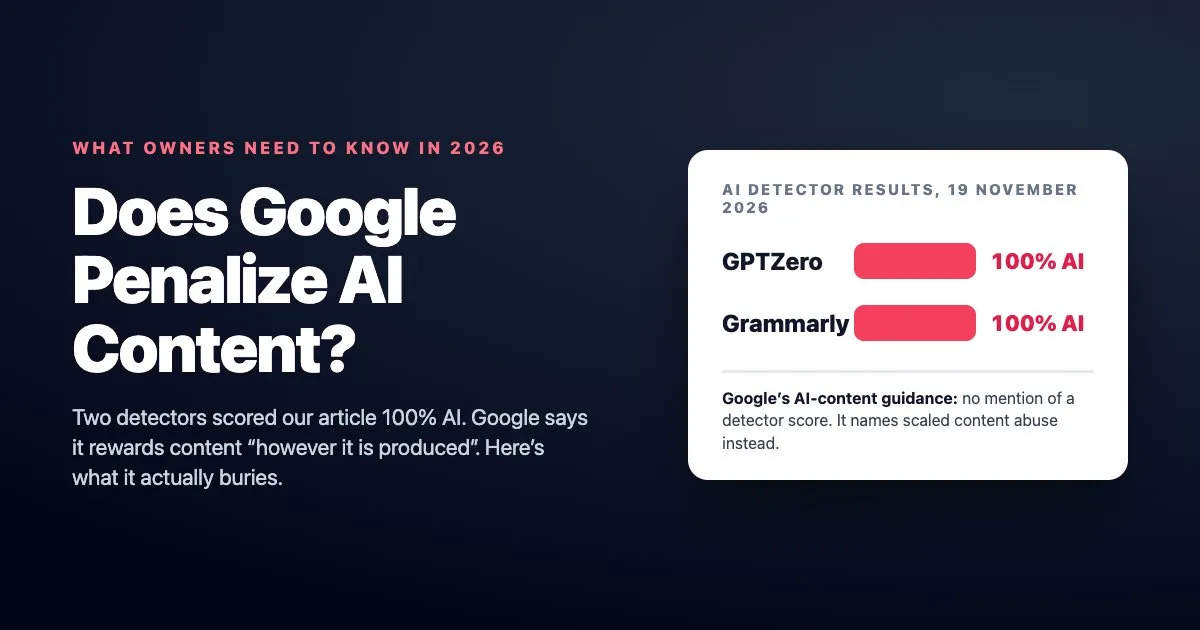
Quick answer: Does Google penalize AI content? Not for being written by AI. Google says it rewards helpful, original content "however it is produced", and its spam policies target pages made mainly to manipulate rankings, which it calls scaled content abuse. No detector score is part of that. What gets AI-written pages buried is thin, generic text with nothing of your own in it.
You wrote your service pages with ChatGPT, or you paid someone who did. Then you read that Google punishes AI content, and now you're wondering whether to take them down. Keep them up for a minute. Let me show you what happened to one of mine.
The day two detectors called our article 100% AI
On 19 November 2026 I took an article I had just published on OrbitWeb's blog, Why Is My Website Not Generating Leads? Because It Just Sits There, and pasted it into GPTZero, then into Grammarly's AI detector. Both came back with the same number: 100% AI-generated.
I'd drafted that piece with AI help, from my own notes and from speed tests we ran ourselves on 1,277 Ontario trade and clinic websites, then edited it. The detectors didn't care. They score the words, and the words still had the shape a model gives them: even sentences, tidy lists, one rhythm from the first paragraph to the last.
My first reaction wasn't fear of Google. It was closer to embarrassment, and a rule came out of it: copy should be assembled, not just generated. The second reaction was a question. What do these tools measure, and does Google look at any of it?
What a detector score measures
A detector doesn't know who wrote a page. It estimates how predictable the text is to a language model, and predictable text gets labelled AI. That's why the scores are so shaky.
OpenAI launched its own detector on 31 January 2023. In OpenAI's own test it caught 26% of AI-written text and wrongly flagged 9% of human writing. On 20 July 2023 the company pulled it, with a one-line note: the classifier "is no longer available due to its low rate of accuracy."
A study in the journal Patterns, published 10 July 2023, ran 91 essays by non-native English speakers through seven popular detectors. On average they flagged 61.3% of those human essays as AI, and at least one tool flagged 97.8% of them, while 88 essays by US eighth-graders were classified almost perfectly. Plain, careful English reads as "machine" to these tools.
A second study, in the International Journal for Educational Integrity, tested 14 tools and found them "neither accurate nor reliable". Even the vendors say so. Grammarly's page states "No AI detector is 100% accurate", and GPTZero's FAQ says its results "should not be used to punish students."
So a 100% score told me something about my sentences. It told me nothing about how Google would treat the page.
Does Google penalize AI content? What Google says
Google answered in writing on 8 February 2023, in a Search Central post called Google Search's guidance about AI-generated content. Its first heading is "Rewarding high-quality content, however it is produced", and its FAQ says: "Appropriate use of AI or automation is not against our guidelines."
The same post draws the line that counts. Using automation "to generate content with the primary purpose of manipulating ranking in search results is a violation of our spam policies." On ranking, Google is blunt: "Using AI doesn't give content any special gains. It's just content. If it is useful, helpful, original, and satisfies aspects of E-E-A-T, it might do well in Search."
E-E-A-T is Google's shorthand for expertise, experience, authoritativeness and trustworthiness. Its helpful content page adds that "trust is most important" and asks whether your pages show "first-hand expertise and a depth of knowledge".
Google's page on using generative AI content, last updated 1 October 2026, adds the warning every owner should hear. Generative models predict words, they don't retrieve facts, so Google tells you to manually fact-check and review all AI-generated content "for accuracy and trustworthiness before publishing."
Go and search those pages. Not one of them mentions a detector score.
What actually gets content buried
Google's spam policies name the problem. "Scaled content abuse is when many pages are generated for the primary purpose of manipulating search rankings and not helping users." The first example on the list: "Using generative AI tools or other similar tools to generate many pages without adding value for users."
That policy arrived with the March 2024 core update, announced 5 March 2024, and it applies "no matter whether content is produced through automation, human efforts, or some combination of human and automated processes." And the consequence is written down too: sites that violate the policies "may rank lower in results or not appear in results at all."
Then there's the quieter failure. Google's rater guidelines have a section for main content "created with little to no effort, little to no originality, and little to no added value". A page like that gets no penalty. It just loses to a page that says something.
You've seen these pages. Twenty town pages where only the town name changes. A services page that would fit any plumber in Canada. None of that needs a detector. Google only has to notice that your page says nothing the others don't.
A checklist before you publish anything AI helped write
I use this list for articles and service pages alike, and it's the same list behind website copy that converts. The fix in both cases is specifics.
- Put one thing only you know in every section. A job from last month, your real price range, the question customers ask at the door. A section with none of that is filler.
- Check every fact yourself. Numbers, dates, product names, your own hours. Google asks for this in writing.
- Read it out loud. If a sentence is something you'd never say to a customer, rewrite it in the words you would use.
- Say who wrote it. Google asks for accurate bylines where readers would expect one. Put your name and two lines about you on the page.
- One page, one job. A page about furnace repair in Guelph should be about furnace repair in Guelph, with details only a company that works there would know.
- Don't publish in bulk. Fifty pages in a weekend is the exact shape the scaled content policy describes.
- Add what a model can't. Your photos, your reviews, a line from a customer, a before and after.
- Treat a detector score as a mirror, not a verdict. If a tool flags a paragraph, ask whether it says anything specific. Usually it doesn't, and that's the part worth rewriting.
How we write now: assembled, not generated
Here's what that rule means at WebCore. Before we draft a page or an article for a business, we collect the raw material from the owner: the jobs, the prices, the towns, the photos, the questions customers ask. Each section then has to carry at least one thing only that business has. If it can't, the section gets cut or the owner gets a call.
After the draft, we read for the patterns that read as machine-written: the same sentence length line after line, the stock transitions, the neat three-item lists, the words nobody says out loud. Then a person reads the whole thing before it goes live. What we don't do is promise rankings from any of it. We talk about results we've measured, and nothing else.
If you'd rather not do this alone, that's the job WebCore does. What WebCore is, in one line: an AI for revenue for small business owners. It runs your website, answers your visitors, keeps every enquiry in one Pipeline and does the SEO work, and when we write for you we start from your material. Start with the one service page you want more calls from.
Frequently Asked Questions
Does Google penalize AI content?
Not for being written by AI. Google's guidance since 8 February 2023 says appropriate use of AI "is not against our guidelines", and that AI gives content no special gains either. Its spam policies punish pages made mainly to manipulate rankings, whether people or software made them.
Can Google tell if content was written by AI?
Google doesn't say it runs a detector. It says it has systems, including SpamBrain, that "analyze patterns and signals to help us identify spam content, however it is produced." The pattern it describes is scale without value, not a writing style.
Do I have to tell readers I used AI?
Google calls AI disclosures useful where a reader would wonder how a page was made, and asks for accurate bylines where readers expect one. A real byline and real details do more than a disclaimer, and on an article drafted with AI a short note is fair.
Are AI detectors accurate?
Not reliably. OpenAI withdrew its own classifier on 20 July 2023 "due to its low rate of accuracy" after it caught 26% of AI text and wrongly flagged 9% of human text, and the 2023 Patterns study found seven detectors flagged 61.3% of essays by non-native English writers as AI.
What is scaled content abuse?
Google's definition: "many pages are generated for the primary purpose of manipulating search rankings and not helping users." Its examples include generative AI pages made "without adding value for users", scraping, and stitching content from other sites. It became a named spam policy on 5 March 2024.
Can AI-written pages rank on Google?
Yes, when they're useful and original. Pages built from your own jobs, prices, towns and customer questions show what Google calls experience and expertise, and pages that read like everyone else's don't. If you also want AI assistants to mention your business, that playbook is here.
What does E-E-A-T mean?
Experience, expertise, authoritativeness and trustworthiness, the qualities Google's systems try to reward. Google's helpful content page says trust is the most important of the four and that a page doesn't have to show all of them. First-hand experience is the one a small business has and a language model doesn't.
Should I delete the AI content already on my site?
Not because of how it was made. Open each page and ask whether it says anything a competitor's page doesn't. Keep the ones that do and add your own numbers, photos and examples. Merge or remove the ones that exist only to hold a keyword.